Perfect products are finished
Loved ones are invitations
Loved ones are invitations
Khoric Design
Some products arrive complete. Others arrive as questions only the user can answer. Khoric Design is a design practice for products that are deliberately incomplete. It gives perspective and language to see and discuss where to manage for control and where to design for potential.
In 2003, LEGO had the world's best toy brand and the world's worst toy business. The company had lost 30% of its turnover in a single year. Debt had reached $800 million. Bankruptcy was months away.
The survival plan was decisive and effective. LEGO stripped away everything that wasn't working: theme parks, clothing lines, publishing. They cut product lines from 13,000 SKUs to 7,000. And they leaned into franchise licensing. Star Wars, Harry Potter, Marvel. Sets with instructions. Clear builds. Recognizable worlds. Star Wars alone drove revenue up 35%. By 2015, LEGO had surpassed both Mattel and Hasbro to become the largest toy company on earth. It was the product paradigm at its best.
And it quietly changed what LEGO was.
The branded sets that fueled the recovery were beautiful. They manifested worlds we loved in play, or so we thought. It took some time to catch on to what was happening. The brick, which had always been an invitation to imagine, had become a delivery mechanism for licensed stories. The sets taught children to follow steps and replicate worlds that belonged to someone else. The numbers were extraordinary, and in a company that had nearly died, good numbers end arguments. Grandparents who once gifted imagination now bought a Hogwarts castle. A perfect movie moment in plastic bricks with easy to follow instructions. Assembled once, never used for play.
Around the same time, a game developer in Sweden named Markus "Notch" Persson released a game that made no sense by any conventional measure. Minecraft had no story, no winning conditions, and almost no rules. A journalist asked Notch what players were supposed to do. He said he didn't know. That was kind of the point.
Minecraft became one of the best-selling games in history. Kids lost sleep over it. Adults built entire cities in it. Nobody in the games industry could fully explain why it worked, but people who remembered playing with LEGO bricks as children recognized the feeling immediately. Notch himself said the game was inspired by those childhood memories.
He tried to help. A lifelong LEGO fan, Notch approached the company and built a working prototype of a LEGO-branded version of Minecraft. He called it Brickcraft. But LEGO's process, shaped by a decade of franchise-driven product development, imposed so many rules and constraints that Notch's team walked away from the deal. LEGO tried again on their own with LEGO Universe, a polished MMO with storylines, combat, and progression systems. It shut down after fifteen months. They tried a third time with LEGO Worlds. It launched without a bang, but next to Minecraft it looked like a whimper.
LEGO saved their business and lost their way. Today, parents who grew up with the old bricks award their kids extra screen time on Minecraft because that's where children go to be creative. The thing LEGO once owned, open-ended play, now lives inside a game made by someone who loved their toy more than they did.
The playbook that pulled LEGO out of crisis could not produce something like Minecraft. Clear goals, controlled outcomes, polished execution. Every principle that had saved the company now stood in the way. Because Minecraft is not a product. It is something else. Something the playbook has no name for.
The product paradigm has no way to describe what Minecraft is, or why the original LEGO brick worked, or what Wikipedia did when it handed editorial control to strangers, or why Warhammer 40,000 thrives by making you assemble and paint your own figures before you can play. These are among the most loved and enduring products on the planet. The product paradigm can only see them as outliers and reach for words like "hobbyist culture," "great branding," "strong community." Accurate enough. But it cannot see the pattern connecting them.
In the eyes of the product paradigm, Minecraft has no value in itself. It relinquishes control and responsibility for the outcome. As if it merely gives form to the real value: what the user creates. This halfway thing, this vessel for creation, was described by Plato thousands of years ago. He called it khôra: the space that enables becoming. The thing that holds creation without controlling it.
Khoric Design is the practice of making unfinished objects on purpose.
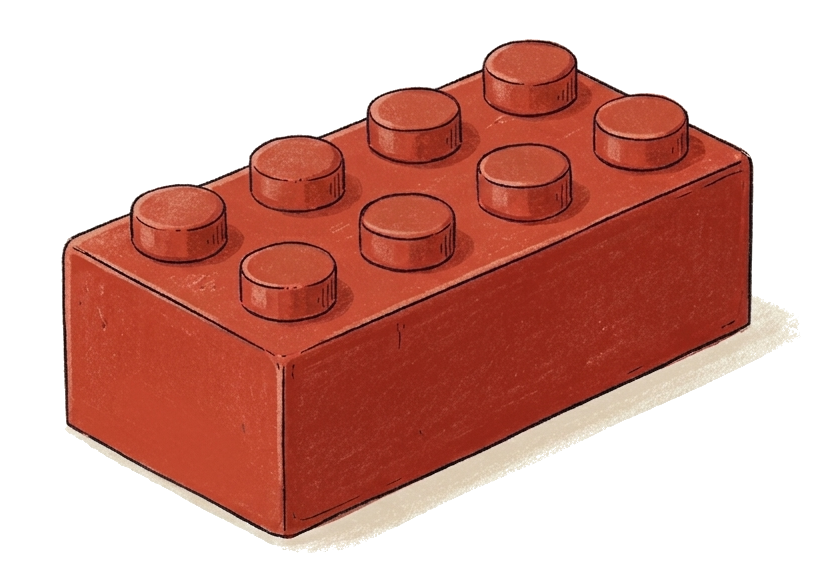
A khoric object is one that enables creation without deciding what gets created. The LEGO brick is a khoric object. Minecraft is a khoric object. Wikipedia is a khoric object. A Star Wars LEGO set defines the imaginative space and turns creation into production. It is a perfect product. But what part does it ask the child to play?
Khoric Design asks the user to be the Creator. The one who picks up the brick and builds a house, a horse, or whatever they want. The Designer is the one who made the brick. The Designer builds the conditions for creation. The Designer does not decide the outcome. The Creator does.
The product paradigm and the Khoric paradigm are not in conflict, but they are in tension. The product paradigm creates certainty. The Khoric paradigm creates potential. Potential is inherently uncertain. Most products need both, and many of the hardest design decisions live at the boundary between them.
LEGO needed the product paradigm to survive 2003. The franchise strategy, the operational discipline, the clear metrics: all of it was necessary and well executed. But when the company tried to build something that required a different kind of thinking, the same discipline became a constraint. They could not produce the digital version of their own original idea because the paradigm that saved them had no language for what that idea actually was.
Khoric Design gives it a name. And a name is where a new practice begins. LEGO may yet find their way back to the brick. The framework they need to get there starts here.